It was one of the most emotional documentaries ever aired on the Showtime Cable Network. Now, for the first time, on December 6, fans will have a chance to own The Love We Make, a look back at Sir Paul McCartney and his efforts to plan and perform a benefit concert in the aftermath of the worst day in the history of New York City.
Eagle Rock Entertainment will release the film, directed by Albert Maysles (Gimme Shelter) and Bradley Kaplan, on DVD and Blu Ray. Shot in stark 16 mm black and white, complete with color concert clips, The Love We Make juxtaposes dramatic images of “The Concert For New York City,” held mere months after 9/11, with that of scenes of McCartney himself as he walks the streets of the town that his former songwriting partner, John Lennon, loved so much.
“It was an honor to be able to help New York and America at that time in its history,” said McCartney of the concert. “There was a feeling of shock and fear in the air that I thought we could help alleviate with music and the fact that so many people stepped up to join us made for a very uplifting evening for us all.”
Recorded in DTS-HD Master Audio, Dolby Digital 5.1 and LPCM Stereo, the 90-minute film features cameo appearances by President Bill Clinton, Mick Jagger, David Bowie, Eric Clapton, Sheryl Crow, Leonardo DiCaprio, Harrison Ford, Jay Z, Billy Joel, Elton John and many more in onstage and backstage moments.
It is a film that no music fan can afford to miss.
Mimic (disambiguation). It is that effort to imitate something else. Imitation. Fake. Something that is not the real thing but tries to appear to be the real thing. Yet, bands that mimic successful bands are not necessarily fakes or imitations. There is a whole cottage industry in “cover bands” that faithfully mimic the originals down to the feather boas and black tights. These are the “fake” bands that mimic the original bands.
There is a completely separate side to successful band mimicry and it depends on what the band mimics. Many music genres are made up solely of mimicry. The bands in a genre sound alike because they mimic a style and feel of music. They take you on a similar journey, with similar tools, but usually with their own twist.
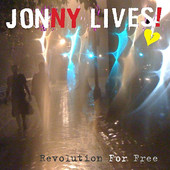
Jonny Lives!’ new release, Revolution For Free, mimics Green Day on the track “Parking Lot” and Coldplay on “Still Dreaming. The mimicry continues with a early Beatles-like effort on the cut “Your Money Or Your Life,” a flashback attack of the Kinks on “Breaking Down,” and a Kokomo-era Beach Boys on “Vagabond Lovers.” The band also lets go with punk and pop rock pieces that may remind you of someone else’s music or style - maybe a prescription of Ted Leo and the Pharmacists, a shower of Fountains of Wayne or a kick or two of The Clash.
Jonny Lives! may sound familiar but the band and its music is hardly fake. Revolution For Free is energetic, well-written, well-produced and well-performed. The band, anchored by frontman Jonny Dubowsky, puts out a solid and thoroughly enjoyable recording.
The saying is “imitation is the sincerest form of flattery.” I picture Hall of Fame rockers listening to Revolution For Free, wry smiles curling their lips as they hear sounds that remind them of their recordings, then raising devil horns - rock on! Jonny Lives!
Every generation has a band that defines their era. Fortunately for my generation, Oasis is that band. Some might argue Radiohead clearly defined the 1990s, while others might say Pearl Jam, Nirvana or even a different band. Only Oasis has consistently remained remarkable all throughout their career thanks largely due to their amazing songwriting capabilities. The early 1990s saw the emergence of alternative and grunge music as mainstream music. When grunge and Nirvana disappeared, Oasis was one band ready to take the torch. Could it really be 15 years ago when I was first introduced to Oasis? As the name of their new singles compilation, Time Flies:1994 -2009, implies, that’s true. Looking at those words on the screen I am still shocked it has been that long. Still, Oasis remains one of the most talented rock n’ roll bands around. The album celebrates Oasis’ entire body of work. Oasis has sold over 70 million records worldwide and their legacy still remains strong even after Noel Gallagher left the band in August 2009. Beginning with their debut single “Supersonic” to the final track “Falling Down,” the album is jam-packed with 26 irresistible singles. Music was revitalized readily by two brothers named Liam and Noel Gallagher in the early 1990s. Oasis breathed fresh air into the music industry and gave birth to Brit pop. Although they despise the term, like the Beatles during the British Invasion of the 1960s, Oasis opened the door for other British pop bands during the mid to late 1990s. Their presence helped open the door for future European pop bands to cross over into America. Magnetic, majestic and mesmerizing, they sold millions of records to become one of the best pop bands in the world. Listening to their music now I can’t help, but get taken back to when I first heard that particular song when I listen to the album. Their breakthrough song, “Wonderwall” is arguably my favorite song, but more importantly, the song that introduced me to Oasis. From the moment the song begins I am immediately transported back in time to fall 1995. Oh, what a feeling! How many bands have that ability? Unlike most contemporary compilations, Time Flies, is an engaging, entertaining and eclectic album that comes across as a concert set list instead of “a greatest hits album.” Energized by memory filled tracks like “Supersonic,” “Don’t Look Back in Anger,” “Lyla,” “Live Forever,” etc. this is a definitive album every 1990s music aficionado should own. Call me crazy, but this is a must own album. Time Flies does include two previously unreleased tracks “Lord Don’t Slow Me Down” (2007) and “Whatever” (1994), but for Oasis haters, they will criticize it’s mostly “A” side tracks and misses what the Stop the Clocks album accomplished by having more obscure/ “B-side” tracks. Sure, that’s true, but not everyone is interested in bootleg and/or obscure songs. If you’re an Oasis fan this is a must own for your collection.
Sultry, sensuous, ominous and emotive. These are the words that come to mind while listening to Bettye LaVette’s 2007 release Scene Of The Crime. If you don’t know Bettye LaVette you should. Ms.LaVette is one greatest soul singers in American music history. She’s been singing her heart out in relative obscurity for over forty years. She cut her first record in 1962 at the age of 16. She’s covered everyone from the Beatles and Neil Young to Kenny Rogers and Etta James, and has even had Stevie Wonder write songs expressly for her. One of her managers, the late Jim Lewis, back in 1968 had her study Sarah Vaughan and Frank Sinatra for phrasing and timbre manipulation. When you listen to the entirety of Scene Of The Crime you realize she was a great student that evolved into the master. She has a scientific approach to music. When singing covers she takes copious notes about each song in order to find her own approach to the lyric, melody, and arrangement.
The album Scene Of The Crime was primarily recorded at FAME Studios in Muscle Shoals, Alabama with the Drive-By Truckers. On it she covers a variety of country and rock songs and turns them into evocative tales. The album was nominated for a 2007 Grammy Award for “Best Contemporary Blues Album” The album also features one song co-written by LaVette and Patterson Hood, the Drive-By Truckers’ frontman, a rollicking biographical musical trip through LaVette’s life aptly named “The Battle Of Bettye LaVette.”
This ten track album deserves to be in every contemporary music fan’s collection. You haven’t truly heard Don Henley’s “You Don’t Know Me At All”; Willie Nelson’s “Somebody Pick Up My Pieces”; John Hiatt’s “The Last Time”; or Elton John’s and Bernie Taupin’s “Talking Old Soldiers” until you have listened to LaVette’s raspy dramatic renditions. She even outdoes Ray Charles on Charles’ version of “They Call It Love” and George Jones on Jones’ version of “Choices.”
LaVette produced this album herself, although you can also hear the hand of David Barbe, a great musician in his own right who has produced every Drive-By Truckers’ album, as well as Son Volt, in the mix. LaVette was also able to secure the keyboard services of legend Spooner Oldham who is best known for his organ work on "When a Man Loves a Woman" by Percy Sledge, "Mustang Sally" by Wilson Pickett and "I Never Loved a Man" by Aretha Franklin.
For 40 minutes Lavette grinds out ballads and roots rockers and for 40 minutes you will be transfixed by greatness. Pull this one out on a cold, quiet night. LaVette will provide you with all the heat you will need.