Showing posts with label free jazz. Show all posts

Friday, March 23, 2012

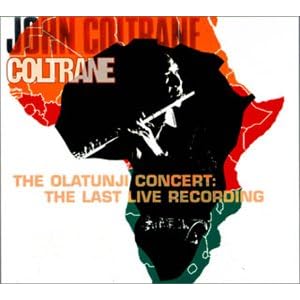
John Coltrane -The Olatunji concert: the last live recording

 Olatunji Concert: Last Live Recording

I have literally all of Coltrane's Impulse! label CDs, as well as the vast majority of his recordings for a myriad other labels.

The Olatunji Concert (below reviewed, if you're patient) is Trane's last live recording: he died at age 40 in 1967.

Putting any Coltrane CD/record on is like devout Catholics lighting a censer: I trust it completely.

Coltrane taught me to love jazz (and was my gateway drug to the whole genre, if you will); he is why I play tenor and soprano sax. He is why I play anything but a guitar and drums.

In my mind Coltrane, like early-era Metallica, is the ideal artist:

in the grandest, most pretentious, and most indespensible way possible, he's what all humans should aspire to: he does what he wants, when he wants, in an attempt (however futile or not, depending on your view) to connect to Divinity.

To express himself as purely as possible, and to be heard in this way by others.

So with this first of the posthumous releases (obviously?), we get what is referred to as "late-period Coltrane."

For those of you not up-to-the-minute on jazz mythology (which probably speaks well of you), "late period" Coltrane means free jazz, which means solos as absolutely-goddamn-long-as-we-wanna-take-them.

In all honesty, it means the type of jazz that may've, in some great probability, turned you off of jazz in the first place (if you're not a fan). It means noodling, and annoying effete intellectuals describing using the "negative space" in soloing-- it means balding geeks who majored in music composition talking about "playing what's not there, man...."

Now, you're gonna have to trust me here. But I think I'm onto something, and you might benefit from reading further:

Jazz...

is the greatest form of music-- ever.

Even beyond metal-- and this is from someone who has listened to, for the most part worshipped (and reviewed, as perhaps you've noticed) metal for over 30 years.

I love metal like a mother loves her children-- no hyperbole.

But jazz, real jazz, is music with talented musicians who feel each other's presence like Jean Gray psychically feels Scott Summers-- it's the closest humans get to God Making Sound.

I know:  it's quite a claim.

Both 'Trane's grandfathers were preachers-- and I genuinely doubt this is a coincidence. If you listen to a typical interview with him, he sounds like the archetypal preacher-- slow-spoken, contemplative... suggestively all-knowing, yet humble.

I owe a small fortune, the GNP of a small island nation, in student loan debt for my psychology degrees-- but I would punch Carl Jung and Rollo May in the FACE for the chance to talk to John Coltrane, even for a few minutes.

The fact is, I could've review any Coltrane album: for my own site, I've review several of his (in my mind, however limited that may be) better records. But note the cover photo, above: we're talking about a man who made his reputation on playing a particular instrument (the tenor, and later the soprano, sax) and was so debilitated by disease that he couldn't continue to play the tenor sax physically (they usually weigh about 22 lbs) and SO LAID DOWN AND CONTINUED TO PLAY THE FLUTE ON SOME TRACK BECAUSE IT WAS ALL HE COULD PHYSICALLY LIFT.

This fact embarrasses me when I complain about my callused hands from playing the guitar.

The wailing, the noise from the tenor, pushes you towards some questions:

is it clinically interesting, as in "so this is what a psychotic break sounds like?";

is it viscerally interesting, as is "Yes! This is touching God!";

Yes to both, though I guess is depends on for whom you're rooting.

It's three (though essentially two) tracks over its hour-long-ish running time. The first track is a half-minute intro from Dr. Billy Taylor (who unfortunately died recently) and the remaining two tracks are "Ogunde," (29 minutes, from Trane's recent Expression LP, his last studio recording),  and the Coltrane standard "My Favorite Things" (35 minutes) in a form Julie Andrews only dreamt of in her opium night-sweats. Assuming she had those, I mean. She seems kinda clean-cut, but you never know.

Pharoah Sanders is here too, on the tenor, as is Coltrane's wife Alice on the piano, along with Jimmy Garrison on the bass, Rashied Ali on drums, Algie DeWitt on the Batá drum and Jumma Santos on percussion.

If you're new to jazz, genre-curious, one might say-- do NOT start with this.

That would be like someone who's decided they like might like Bon Jovi being told to check out Watain. This is the extreme end of free-jazz, and even many jazz aficionados don't like it. If you want to dip your toe in, start with Coltrane's Ballads or Miles Davis' (also featuring Coltrane) Kind of Blue. Then decide if you wanna go further.

If you do play it, play it loud and give it your utmost attention. I'm not gonna lie-- this record is perfectly suited to being very, very high.

You know, like the best metal.

--Horn

Wednesday, March 14, 2012

Shining - Live Blackjazz


Day One:
I drove right up to the hotel entrance.  It was the day the Undersight Hotel shut down for the winter season.  The hotel manager walked out to meet us with a big smile on his face.
“Ah Mr. Penfold.  I see that you’ve brought your wife.”
“Ha, good heavens no!  I’m not married.  This young lady’s name is Sonja.  We’re simply complimentary workers based on what we each do well.  Together we form the perfect hotel-caretaker.”
“I see?  Well this must certainly be your child.”
“Wrong again sir.  I’m only this young man’s mentor.  The Big Brother branch director thought it would do Knut good to get out of the city for a while.  He’s under some delusions about seeing ghosts.  Crazy huh?”
“Ha…ha…crazy…yes.”  He clears his throat.  “May I ask what you’ll be doing to keep busy?”
“Certainly.  I am a saxophone player and I intend to work diligently to improve my improvisational skills.”
“That’s fantastic!  I love jazz.  It’s so much better than that barbaric filth produced by those rock and rollers.  You know we had another jazz musician watch over the hotel a few years ago, but he…”
“He what?”
“Oh never mind.  It’s not important.  You just stick with your saxophone Mr. Penfold.”

Day 30:
“Good morning Penfold.  How is your practicing coming along?”
“Good morning to you as well Sonja.  My improvisation is improving greatly!  Thanks for asking.  I am feeling a bit restless musically however.  Say, how’s Knut doing today?”
“It’s the strangest thing Penfold.  I went to his room earlier and I saw that he had taken a tube of my lipstick and scrawled LATEM on the wall.  I don’t know what it means, or even what language the word belongs too.”
“Well I don’t think it’s profane so I say we forget about it.”
“Okay Penfold.  That seems wise.”

Day 37:
“Penfold, is something wrong?  Why did you stop playing your rhythm changes?  You need to keep practicing so you can perfect your craft.”
“Sonja, maybe I need a break okay?  I love jazz, but I love other music too!  Wanna know something?  It’s hard to focus on only one genre of music for so long.  Besides, who are you to tell me what to do?  I’ve got an idea.  Why don’t you GET OUT OF HERE!?!?”

Day 42:
Sonja enters Penfold’s practice space and picks up a piece of discarded sheet music from the floor.  She recognizes Penfold’s handwriting and quickly reads the first few lines of text.

All jazz and no metal make Penfold a dull boy…ALL JAZZ AND NO METAL MAKE PENFOLD A DULL BOY…All jazz and no metal make Penfold a dull boy

Horror consumes her, and she turns white as a sheet when she looks up to discover Penfold tuning a guitar.  “Oh my!  Penfold, is that an electric guitar?”
“You know it Sonja!”
“What happened to your saxophone?”
“I gave it to Knut.  He’s in the other room working out how to best play it through a distortion pedal.”
“A distortion pedal?  You’ve gone mad Penfold!  Mad!”
“Mad?  Nah, I don’t see it that way.  I just want to rock!”
Sonja ran screaming from the room and subsequently the hotel.   She got in my car, and sped away.  I looked over at Knut who had reentered the room after Sonja’s departure.  He gave me the two handed devil’s horns salute and spoke one word.  “Metal!”
“Yes Knut!  Metal!”
I’m pleased to say that together we rocked the very foundation of the Undersight Hotel!

Friends, humans, waveriders, this is your trusted servant Penfold.  I’m here today to give you the lowdown on a band that I’ve recently introduced into my personal listening universe.  They go by the name Shining.   Unfortunately the introduction of said band has created nothing but chaos and tumult.  You see waveriders, the first time I heard Shining a massive black hole was created inside my mind that quickly devoured every other orbiting musical entity!  To put this catastrophic event into perspective let’s get a little background information.

Shining is a quintet of talented musicians out of Oslo, Norway.  Their ringleader is Jorgen Munkeby, a musical chameleon.  He composes the band’s songs, and he plays multiple instruments (mainly saxophone and guitar) to help bring his musical vision to life.  Shining debuted back in 2001 as an acoustic jazz quartet.  Two years later another acoustic jazz album was released.  Around this time Mr. Monkeby was inspired by a band named Motorpsycho to change his musical approach to incorporate progressive rock and metal along with jazz.  The first album incorporating this new approach, In The Kingdom Of Kitsch You Will Be A Monster, was released in 2005.  Not satisfied Mr. Monkeby continued to evolve his music, making it catchier and heavier over Shining’s next two albums.  In fact the latter of those albums (the band’s most recent studio output) was named after the style of music coined by the band, Blackjazz.  That album came out in February of 2010.  Fast forward almost two years and we have the new live album, appropriately titled Live Blackjazz, which is the topic of discussion here today.

Folks I listened to Live Blackjazz a few weeks back and I was befuddled.  Why had I never heard of this band before now?  What kind of unjust world am I living in which would deny me this knowledge?  Honestly, I became quite enraged.  Allow me to explain why this music so tickles my fancy.  First off I played the saxophone for many years, so any music which incorporates a strong saxophone player will always catch my attention.  Second, I love jazz and I love metal.  It is not often that these two great tastes are combined into a delicious aural meal, but Shining delivers the goods.  I honestly believe that fans of both genres can find common ground with this band.  Yes some songs are more metal than they are jazz, but the opposite is true too.  Trust me, we can all get along.

Apparently there have been questions regarding whether or not Shining can reproduce their recorded output onstage.  Live Blackjazz succinctly puts those concerns to rest.  You may ask how I’m able to make a statement like that considering I was unaware of the band until recently.  I understand your question.  To clarify, thanks to the magic of facebook and soundcloud I’ve gone back and listened to several of the studio versions of these live songs.  The bottom line is that not only is Shining fully capable of reproducing their songs, but like other great bands these live reproductions are more ferocious than their original versions!

True to its title the majority of songs that make up Live Blackjazz emanate from the Blackjazz album.  “Fisheye” and “The Madness And The Damage Done” crush any resistance under their massive metallic assaults.  “Madness…” especially gets my head furiously banging back and forth.  “Exit Sun”, “Healter Skelter”, and Shining’s cover of King Crimson’s “21st Century Schizoid Man” rewrite the definition of the word epic.  Look it up before and after listening.  I guarantee your dictionary will have changed.  Four other songs from the two previous studio albums also make the cut, essentially making Live Blackjazz a greatest hits package.  And what a package it is!

Waveriders don’t let the same thing that happened to me happen to you.  Expose yourselves to the greatness that is Shining right now!  But why stop there?  Do you know anyone who likes jazz?  Do you know anyone who likes metal?  Expose them to Shining too!  Trust me, they will thank you!  I do have one warning however.  Anyone with a history of epileptic seizures should steer well clear of the DVD of this concert.  Remember folks, strobe lights can be dangerous.  You’ve been warned.  Now get to listening!

--Penfold


Friday, February 3, 2012

Waveriders - Here's what the Ripple has in store for you


Waveriders!  First of all, thank you all so much for popping in with us and checking out reviews on the "best music you're not listening to."  Our goal is for our writers to find music that truly excites them, then unleash themselves upon their keyboards to write missives and spread the word.

We've been growing like crazy recently, as we've crossed over 3,000,000 hits and our staff keeps on expanding so here's a preview of what each week has in store for you.  Of course, sometimes things change because of schedules, but basically, here's the rundown.

Sunday begins our week with Cicatriz laying down the hardcore punk and metal, grindcore, deathcore, and occasional variation followed by The Slapphappy Mortician digging into weird worlds of electronica and interesting pop.

Monday is Racer and the Pope writing about whatever catches their ears.  Look for a resurrection of the regular columns we used to do so frequently, like the Proto-metal Report, Musical Martyrs, On the Ripple Desk, and Single Life.  You never know what might catch Racer or Pope's ears for writing that week, but it will probably be full of ambient metal, stoner groove, retro-rock, post-punk, garage and punk.

Tuesday brings on the fuzz with Heddbuzz laying into the stoner groove, doom, and riff rock, followed by Ripple's very own graphic artist, Boogs, writing about what ever rocks his world.  But it will rock.

Wednesday is filled with the missives of Penfold and his regalia of tales as he explores the worlds of avant-metal, hip hop, and pop darkness.  Following which comes our own NW radio personality, Odin, who's all metal all the time. 

Thursday we get entertained by the punky, rocky, metallic, off-the-cuff world of Woody as he delves into his love of all things Motorhead, Stooges, Grand Funk and more.  And don't forget his occasional reading list suggestions, The Ripple Library, with books full of rich rock history.  Then, on days when we're lucky, England's Grifter, Ollie, lays down some heavy riff-rock love.

Friday is heavy, with Horn and his love of metal, sludge, doom and jazz followed by Ripple's newest scribe, Gorgeous Nightmare who delves into metal of all sorts from gothic, to sleaze, to power.

Saturday brings the varied and entertaining worlds of Mr Brownstone and Old School who's ears perk up with wonderously different sounds.  Expect lots of alternative pop, classic rock, blues, jazz and even a touch of bluegrass.  But really, we never know what's going to come next. 

On top of that, we'll still publish the odd bit of news, free compilation links, and interviews.  And the Blogtalkradio link updates every month with the latest podcast from the Ripple Radio Show.

And don't forget to pop over to our companion facebook page, where we'll publish every week (if not every day) links to free downloadable singles, albums, and compilations.

Yes, it's all here on the Ripple.

Tuesday, November 29, 2011

Charles Mingus - Mingus, Mingus, Mingus, Mingus, Mingus


(another album the Ripple crew loved so much, it had to be reviewed twice.  you can read the earlier review here)

Some musical minds are beyond description.  Charles Mingus had one of them.  A jazz musician (a pioneer in double bass technique), a composer, a bandleader and a civil rights activist with a truly American story.  He recorded from at least 1945 through 1977 which was two years before he died of ALS.  He appears on over 100 recordings.  His own music tends to fuse gospel, smooth and free jazz and the big band sound.  The result is an infectious instrumental hard bop.

One of my favorite Mingus masterpieces is all about him - Mingus, Mingus, Mingus, Mingus, Mingus.  Here was Charles Mingus near the crossroads and at the top.

Mingus was forty-nine years old at the time he released Mingus, Mingus, Mingus, Mingus. Mingus.  It was 1963.  Here was a man born in Nogales, Arizona, raised in Watts in Los Angeles in the 1920’s, who by the early 1930’s was studying bass with the principal bassist of the New York Philharmonic. By 1943 he was touring with the Louis Armstrong Band. The man was hot.  So hot that due to his temper Duke Ellington personally fired him after an onstage fight with Juan Tizol, the Duke Ellington Band’s trombonist. 

By the 1950’s Mingus was recording with the “creme de la creme” of modern jazz - Red Norvo, Tal Farlow. Charlie Parker, Dizzy Gillespie, . . .   He co-founded Debut Records with jazz drummer Max Roach and formed his own hard bop jazz quintet.  He also began a rotating group of musicians who played and experimented together known as The Jazz Workshop.

By 1963 Mingus was ramping up to a frenzy of creation.  He released four albums in 1962, four in 1963 and twelve in 1964.  This was a perilous time in American History.  The country was in a “police action” in Vietnam and faced a showdown over annihilation with Russia during the Cuban Missile Crisis   Martin Luther King marched on Washington and, just before Thanksgiving 1963, President John F. Kennedy was assassinated.

It is on Mingus, Mingus, Mingus, Mingus, Mingus that the Charles Mingus of the 1960’s can be put in proper perspective.  The album consists of eight tracks.  A theme develops throughout the recording.  This is music with a purpose. 

The album begins with the soulful deep bass strains of “II B.S.” and is followed with a dissonant wail on “I X Love,” There is syncopation and sorrow within the track “Celia,” Even Mingus’s classic bass rendition of Duke Ellington’s and Boony Bigard’s “Mood Indigo” manages to release the soul and elevate the spirit.  Nowhere is that ability of Mingus’s music more evident than in the wild fast-paced soul music precursor “Better Get Hit in Yo’ Soul.” His virtuosity is confirmed with the frantically-paced plucked bass on “Hora Decubitus.”  Mingus also takes the time to pay tribute to an early contemporary, legendary tenor saxophonist and clarinetist Lester Young, in his composition “Theme for Lester Young.”

The final cut has a decidedly preachy message. The song “Freedom” is the only track on the entire album that has lyrics. In its day the track was so controversial that some copies of the album released by Impulse Records contain one of several alternate tracks. Yet these alternates eviscerate the album as a period piece. 

Freedom is the entire point of Mingus, Mingus, Mingus, Mingus, Mingus. It is a vision of an all-encompassing vision of freedom - not just for African Americans.  It is about political, social, economic and musical freedom.  These themes resonate today in every Occupy Wall Street enclave.  It is because the message of Mingus, Mingus, Mingus, Mingus, Mingus is as old as Moses.

- Old School   


Thursday, November 17, 2011

Old & New Dreams - S/T

In the never ending battle between time and money, I will take time every time. I will also take content over technology. Even though I lost my job a few months ago and money is tight, having extra time to get re-acquainted with old gems on my LP shelves has been very rewarding. The self titled 1979 album from a band of Ornette Coleman alumni called Old And New Dreams has always been a favorite of mine but it was unplayed for many years. Now with the luxury of time on my hands it's back spinning on my turntable on a more consistent basis.

Ornette Coleman's music is a mystery to most and just plain unappealing to some. What no one will deny is that Ornette has played with some of the greatest and most creative musicians who have ever lived. In the mid-70's, as Ornette moved into using electric instruments, some of his best players put together Old And New Dreams to play his acoustic compositions as well as their own. Don Cherry (trumpet), Charlie Haden (bass) and Ed Blackwell (drums) were his key collaborators in the 1950's and Dewey Redman (tenor sax) worked with him in the 1960's. What a band! All of these musicians were part of the so-called New Thing, or Free Jazz, but their roots all ran very deep. In addition to being great improvisers they're all each great composers. When you put that combination together, special things are bound to happen. Like this album.

The album opens with "Lonely Woman," one of Ornette's most famous and accessible songs and their version stays faithful to the original but may even surpass it. ECM Records, who released this album, is well know for immaculately clean recordings. Every instrument is beautifully recorded and reinforces the song's slow boil mysterioso. Charlie Haden's deep bass groove merged with the incredible drumming of Ed Blackwell drive Don Cherry and Dewey Redman to deliver fantastic solos. Blackwell's drumming is simply unbelievable on "Togo," his arrangement of a traditional Ghanese song. You like cowbell? You've never heard it like this before. Side one wraps up with Don Cherry's composition "Guinea," which starts off slow but ends up swinging.

Side two starts off with a great Ornette Coleman song titled "Open Or Close" that Ornette never got around to recording himself. I'm not sure when it was written but it's a classic example of harmolodics in action. Dewey Redman's contribution "Orbit Of La-Ba" has him playing snake charmer melodies on a musette and some more incredible African influenced drum breaks from Blackwell. Haden uses a bow on his bass to create incredible underwater sounds on his tune "Song For The Whales." It's too bad Jimi Hendrix never got to jam with Haden, the tones he produces on an acoustic instrument would have really flipped his lid.

Like a lot of great albums, this is sadly out of print but it should't be too difficult to track down a used copy. Playing this album again after all these years has really reinforced that the simple act of listening to great music can truly be one of life's great pleasures. The album was paid for years ago and the music still sounds like it's from the future.

--Woody